Duvets: warmth and sleep quality – how strong the influence really is
Temperature is not a detail. It affects the stability of your night.
Appointment for a sleep consultation
You fall asleep and wake up during the night because you are too hot or too cold.
You turn the comforter, stick one leg out or look for a cooler spot.
Maybe your partner is freezing while you are hot.
In the morning you don’t really feel rested for no clear reason.
The question is: How much does the comforter actually affect your sleep quality?
Briefly explained
Sleep requires the body to cool down slightly. This is the only way it can switch to stable, deeper phases. If it gets too warm, the system reacts with activation. If it gets too cold, muscle tension increases. Both often happen unnoticed – but reduce night-time regeneration.
Many people ask themselves in such situations: Why am I tired despite sleeping? We shed light on precisely this topic in the article Why am I tired despite sleeping? Because it’s not just the length of sleep that matters, but the quality and stability of the night.
Stable sleep needs a stable climate.
The comforter is therefore not an accessory, but an active influencing factor.
When heat disrupts sleep phases
If heat builds up under the comforter, night-time activation increases. Movements increase, sleep phases become shallower and recovery decreases – often without conscious awakening.
Typical indications are
- night sweats
- Frequent uncovering
- Changing reclining positions
- Restlessness in the morning despite sufficient hours in bed
If you are familiar with this, it is worth taking a closer look at our article Why you freeze or sweat at night. Heat and moisture regulation are often more central than you think.
When freezing also causes restlessness
Hypothermia also affects the quality of sleep. Freezing often leads to increased muscle tension, the body contracts and changes in position increase. Sleep becomes more fragmented without you remembering waking up frequently.
Cold feet in bed are a typical example. They can be a sign that the heat distribution is not correct. You can read more about this in Cold feet in bed.
Temperature is therefore not a comfort detail – it has a direct effect on night-time stability.
Different sensations of warmth in couples
One comforter – two different needs.
Differences in thermal sensation are one of the most common reasons for restlessness in couples at night. If one person is cold and the other is sweating, a temperature conflict arises. Blankets are moved, movements increase and sleep becomes unstable.
The problem here is often not in the bed itself but in the climate.
In such cases, separate comforters or individually tailored solutions can achieve more than a complete system change.
What actually influences the comforter
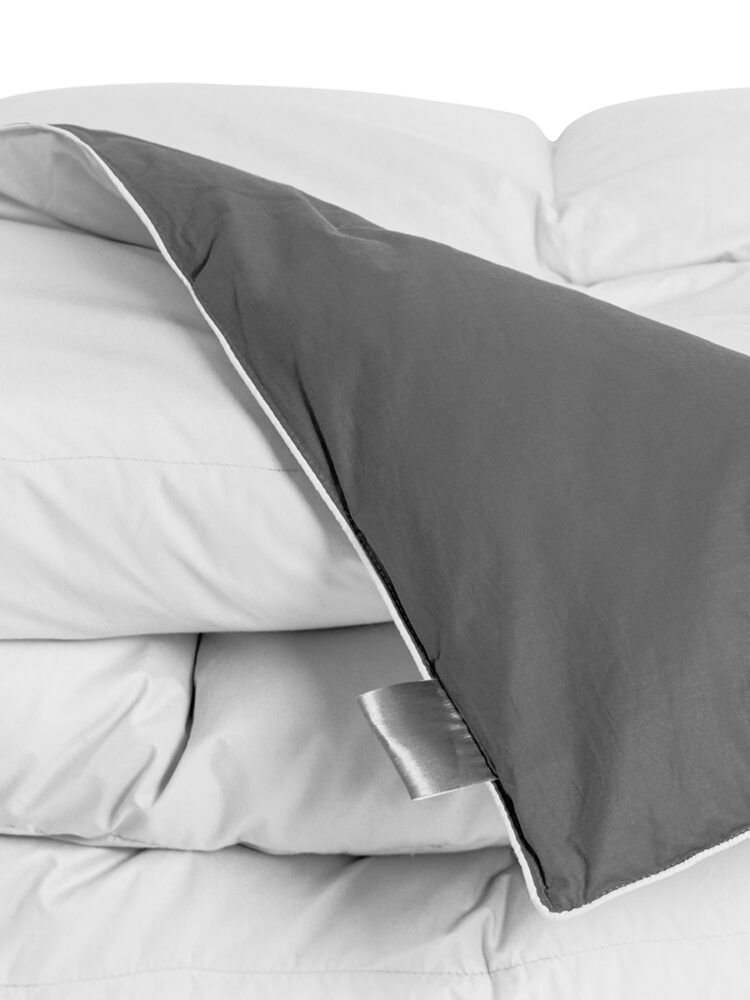
A comforter has a stronger effect than many people think. It not only influences whether you are warm or cold, but also how stable your body is throughout the night.
It controls three areas in particular:
Heat
How much body heat is retained or released? A comforter that is too insulating can cause heat build-up, one that is too light leads to cooling. Both force the body to re-regulate instead of regenerating.
Moisture
The body loses moisture at night. If the material can absorb and release this moisture, the climate remains balanced. However, if moisture is stored, it creates an uncomfortable, heavy feeling of warmth.
Wrapping
Weight and snugness also play a role. A comforter can convey a sense of security and calm or be perceived as too heavy and constricting. This subjective feeling influences how calmly you lie.
These three factors work together to determine how calm your nervous system remains at night.
When a targeted adjustment makes sense
A comforter fitting may be sufficient if temperature is clearly the main issue.
This is typical when:
- You are mainly sweating or cold
- Their storage is fundamentally stable
- there are no pronounced pressure points
- your perception of warmth has changed in a new phase of your life
In such cases, the problem is often not the entire bed, but the climate regulation.
Not every sleep problem requires a complete change. Sometimes the climate is the biggest lever.
When more than the comforter should be checked
If additionally occur:
- Tension
- Pressure points
- Frequent changes of position
- General exhaustion regardless of the temperature sensation
Then it is worth taking a look at the overall system.
This is because the climate, bedding and slat base influence each other. For example, unstable spinal support can change the sensation of warmth. Conversely, heat build-up can lead to more movement and thus increase pressure points.
You can also find guidance on this in the article What is most important for a bed? It often only becomes clear where the actual instability arises during interaction.
Climate is part of the system – not just an accessory
It makes sense to look at the comforter in isolation. After all, it is what you feel directly.
But temperature never arises alone.
Comforter, mattress, slat base and room climate work together. A very warm comforter can make even a well-tuned mattress restless. Conversely, unstable bedding can cause your body to react more sensitively to heat.
That’s why it’s not about the question:
Is my blanket right or wrong?
But about:
Where does instability arise in the system?
Structure instead of trial and error
Many people switch seasonally between summer and winter comforters or test different materials. This is understandable – but does not always lead to clarity.
The crucial question is:
Is temperature my main issue – or is my body reacting to an unstable overall system?
Structure creates security here. Not exchange on suspicion.
Conclusion
Temperature often quietly challenges our sleep – making a balanced bed climate all the more important as a daily basis for rest. Those who pay attention to suitable materials, a harmonious balance of warmth and the interaction in the sleep system create stable conditions for peaceful nights. In this way, the comforter does not become a disruptive factor, but a support – and the night becomes a reliable source of energy for the day. Anyone who is unsure whether climate or system is the decisive lever will find orientation in a structured consultation – adapted to individual needs and life situations.
FAQ – Frequently asked questions
How warm should a comforter ideally be?
So warm that your body neither freezes nor overheats at night. If you frequently wake up or shiver, the balance is usually not right. The aim is to achieve an even, calm climate.
Why do I wake up sweating even though the bedroom is cool?
It’s not just the room that counts, but also the comforter. If heat and humidity are not well regulated, heat build-up occurs – even at low room temperatures.
Does a year-round comforter make sense?
This can work if your thermal sensation is constant. If it changes seasonally or individually, a coordinated solution is often more stable.
Are two comforters better for couples?
If you have different sensations of warmth, usually yes. Separate comforters reduce temperature conflicts and night-time restlessness.
When is it more due to the mattress or bedding?
If pressure points, tension or frequent changes of position also occur, temperature is often not the only factor. It is then worth looking at the system as a whole.
Subscribe to the newsletter now
With our newsletter, you will receive regular tips for restful sleep, information on new products and exclusive promotions so that you wake up refreshed every morning.